Total Pageviews

Wednesday, 15 October 2014

Charles Aznavour: A Trip Down Memory Lane

Another page of my memoir
It has been well over forty years that our beloved Charles Aznavour accepted an invitation to perform at the Armenian Club in Tehran. I was there with my husband. Even after so many years, the image of him in his white suit and the rich sound of his singing are still fresh in my mind.
It was a dinner concert, and after we enjoyed all the familiar tunes, he signaled the finish with a dramatic gesture. He threw his white handkerchief on the floor and then exited the hall quickly. My husband and I were among the very few who followed him outside, and because of that we had the delightful opportunity to sit around a table on one of those warm summer nights in Tehran and chat at length with him and his manager who was also French Armenian.
It was an exhilarating experience. I had to pinch myself to make sure I was not dreaming. I can’t remember what we talked about. But I do remember being surprised at how well he spoke Armenian. We had the good fortune of taking pictures with him too.
Fast forward to 2014: Charles Aznavour turns 90 and kicks off his World Wide Farewell tour with a huge concert in Yerevan. In attendance there were the Presidents of France and Armenia, François Hollande and Serzh Sarkisian.

At the Armenian Club in Tehran. My husband and I are behind Aznavour. First from the left is his manager. The woman on the right is unknown.
At an age when most people hardly step outside their front door, Aznavour is trotting the globe and shows little sign of slowing down. Anybody who has reached 90 deserves a whole year’s birthday celebration. And that’s exactly what he has planned.
After the sensational concert in Yerevan, he performed in Berlin and then continued to other major cities around the world. His L.A. concert was on Sunday, September 13. The Greek Theatre in Hollywood was packed. I was there among the mesmerized audience. On the stage I saw the same Aznavour with the same extraordinary ease he displayed at the Armenian Club 40+ years ago. His rich voice soared across and left his audience in awe. This time he didn’t wear the white suit. Instead, he had a more casual outfit on – no jacket only suspenders over a dark blue shirt.
Aznavour on monitor in Greek Theatre September 13
He interacted with the audience and amused us with a few jokes. I think he was more expressive than I ever remember. He told us that at his age it’s hard for him to sing because sometimes he tends to forget the words. And that was the only complaint I heard he had as a nonagenarian. Then he said he was happy that there was no air conditioning. Then he told us when he wants to compose a song the lyrics come first and the music next.
He finished the nearly two-hour long program as agile as he had started. Sometimes he strolled, sometimes he rested on a director’s chair, sometimes he waltzed his way across the stage. He sang in English, French and Spanish and added a duet with his daughter.
At one point someone from behind yelled, “en Français!” meaning “in French.” A few others echoed the request. I joined them too. Yes, I wanted him to sing in French. I grew up with his songs and perfected my French by listening to his meaningful lyrics.
I was so glad to be there and relive my past memories. What an extraordinary opportunity I had to experience once again with this wonderful performer and witness the outpouring of love from the audience. And what an incredible gift Charles Aznavour has given his fans around the world for his 90th birthday. My only wish is that I will see him once more.


Thursday, 2 October 2014

Armenians living in the Northernmost Island in the World.

This story was published in The Armenian Weekly on line newspaper on October 2, 2014.


Svalbard, an isolated Norwegian island, lies in the Arctic Ocean between 74 and 81 degrees north latitude. During the summer the sun does not set for 99 days, and darkness reigns for 84 days in the winter. The 3,000 or so people that call Svalbard home are considered to live in the northernmost settlement in the world. The majority can be found in Longyearbyen, the de factocapital, while the second largest settlement is Barentsburg with 400 inhabitants.
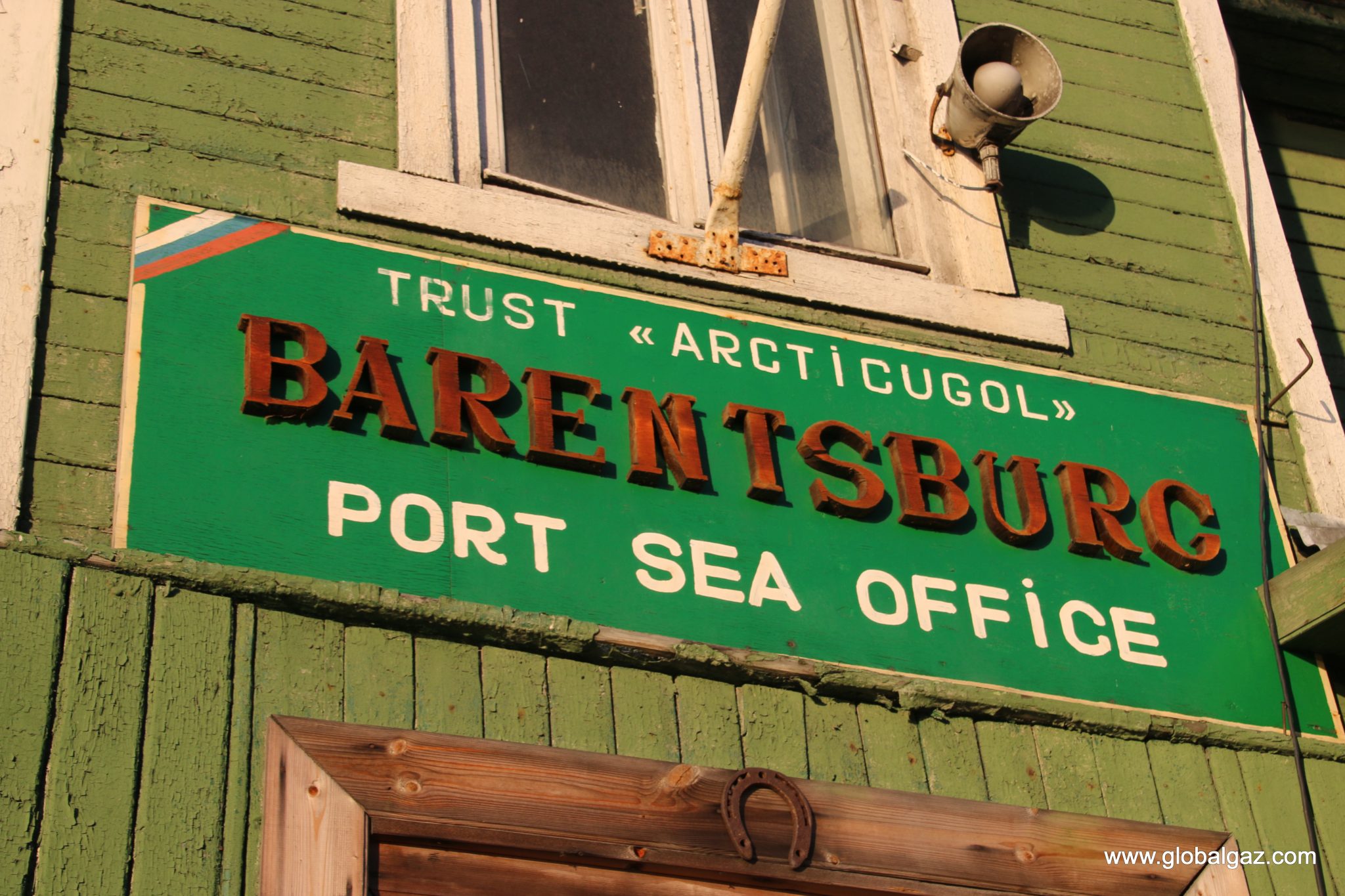
Welcome to Barentsburg.
Despite Svalbard being under Norwegian sovereignty, the lingua de Franca of Barentsburg is Russian. A unique treaty signed in 1920 allowed all signatories to exploit Svalbard’s resources; the only country to have taken advantage of this was Russia.
Barentsburg was originally founded as a Dutch settlement in 1920, but sold their concession to the Soviet Union in 1931. The Soviets—now Russians—have maintained a presence there since then mining coal. The coal is mined by the Russian state-owned Arktikugol Trust, which exports its coal primarily to northern Europe. Everything in the settlement is heavily subsidized, from housing to electricity, resulting in a financial loss to Moscow; yet it allows Russia to maintain a presence in this part of the world. Despite this Russian influence, Barentsburg still maintains both a Norwegian address and phone numbers.
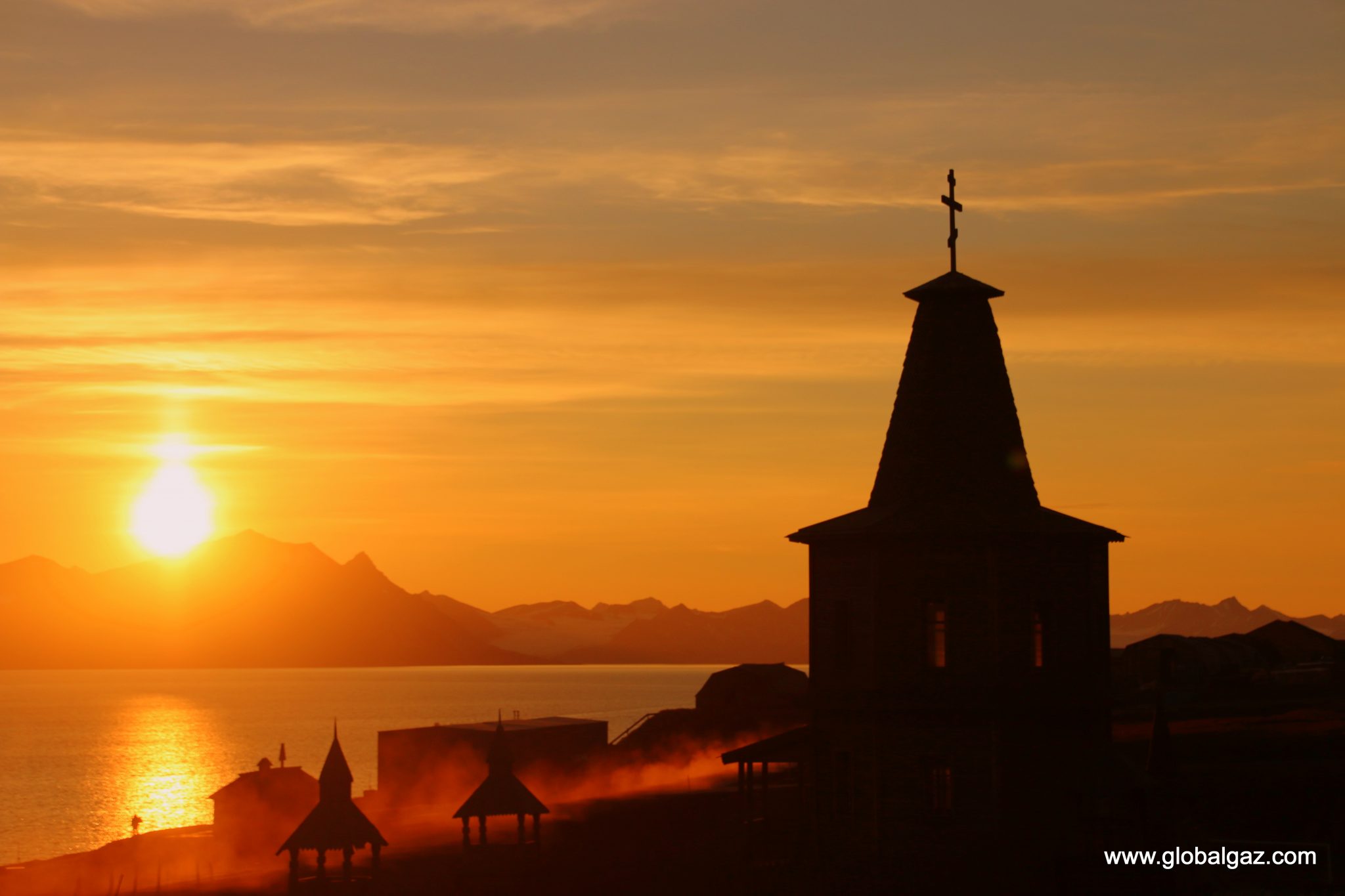
The Russian church built in memory of dead miners.
This isolated mining village has created its own Russian ecosystem. An onion-domed Russian Orthodox Church rests in the settlement, built in honor of 140 miners who perished in a 1996 plane accident. Barentsburg has everything from an Olympic-sized swimming pool to a school, to the northernmost diplomatic mission in the world, the Russian Consulate. No roads lead to this settlement; it can only be reached via boat, snowmobile, or helicopter. Most supplies and food come directly from mainland Russia, and the settlement uses an electronic cash card to make transactions. (One might want to consider using the cash card at the northernmost brewery in the world, the Red Bear Brewery.) Barentsburg is also attempting to bring in its share of the global tourism dollar. A new hotel has been built, and visitors are free to peruse the souvenir shop or catch a performance at the cultural center.
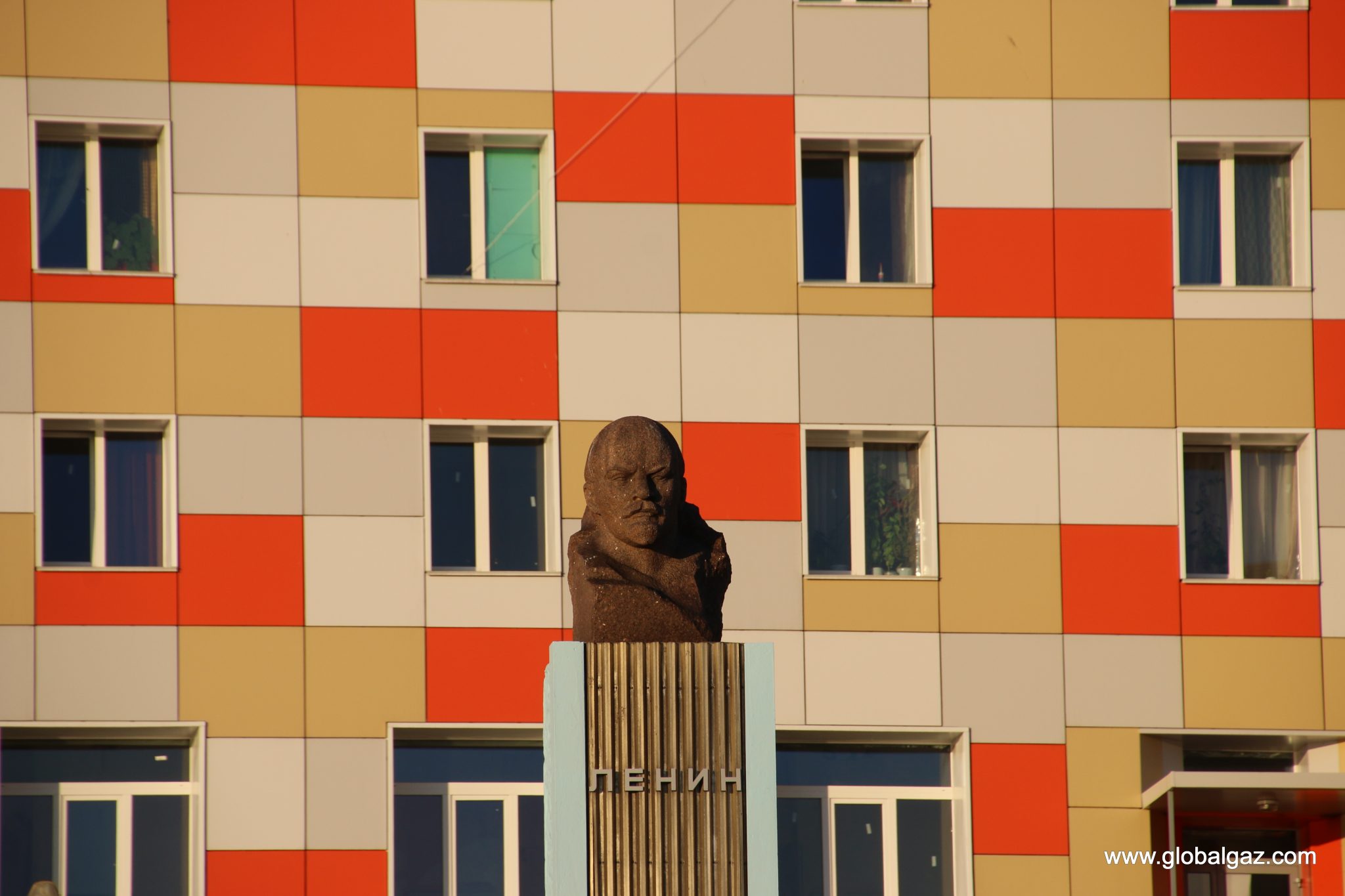
Lenin still runs supreme in a Soviet time warp.
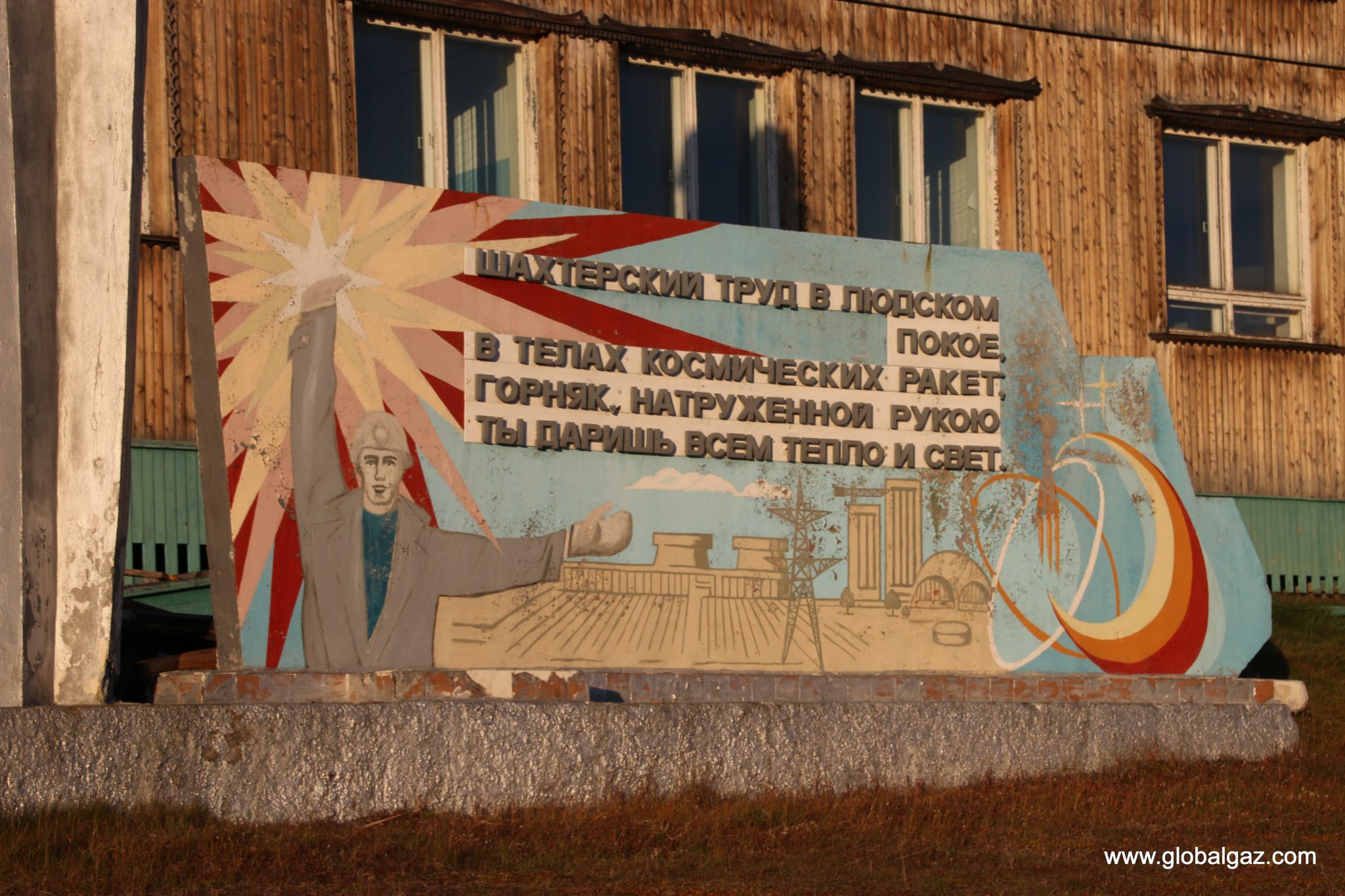
I cannot imagine spending my next long weekend vacationing in Barentsburg, but it was a fascinating place to visit for a couple of hours. The settlement appeared to be stuck in a Soviet time warp. Soviet-like propaganda hugged the walls of the buildings. A plaque highlighted the revolution of 1917. A large Lenin bust hogged the town’s spotlight. (Difficult to believe, but this Lenin statue is not even the most northern statue. A nearby abandoned Russian mine claims that title.).
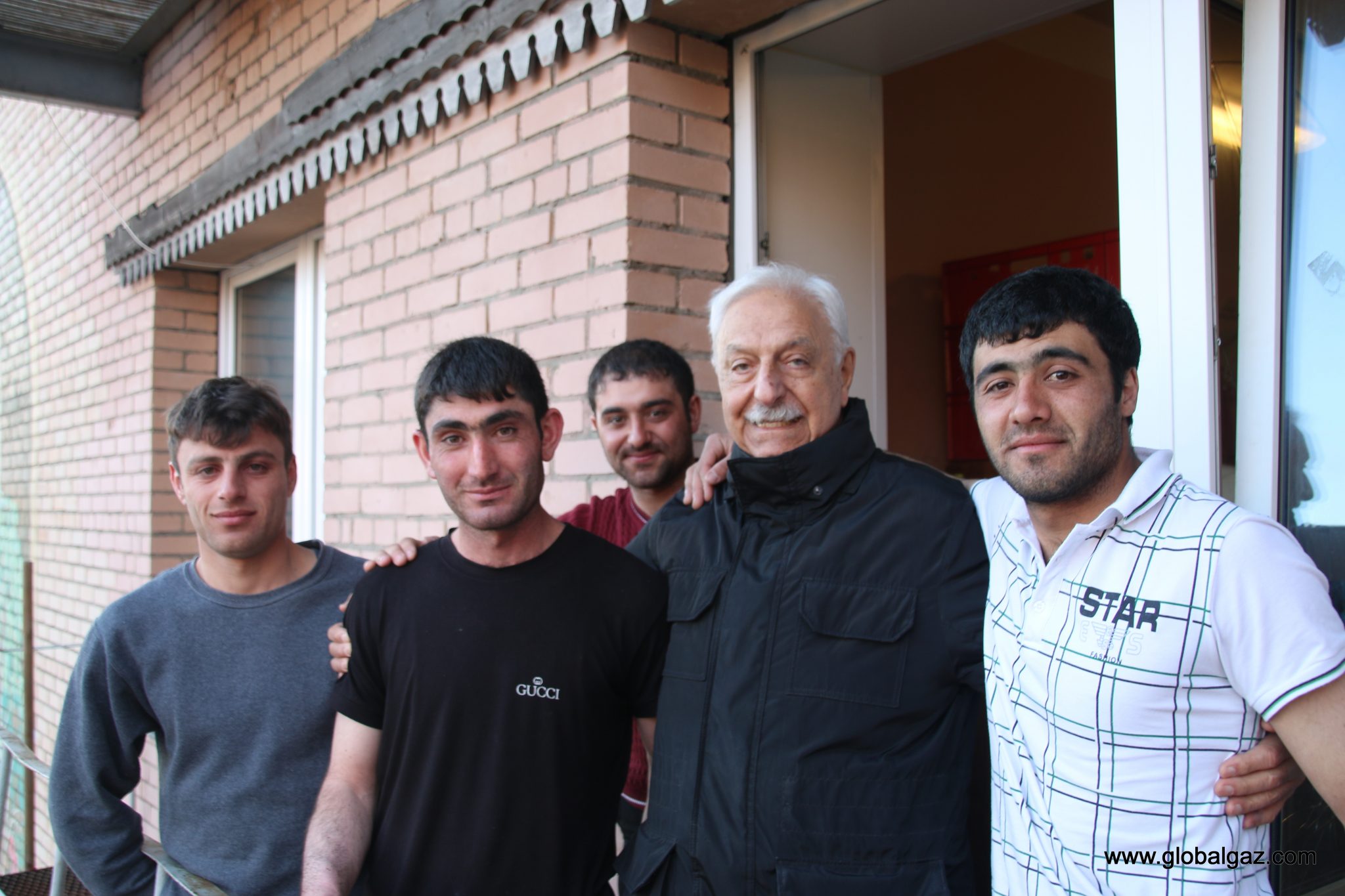
My Dad with our new friends.
As we strolled around Barentsburg, my tour guide, Yuliya, shared with us the pan-Soviet nationality breakdown of the mining workforce. The majority of the workforce hailed from Ukraine, followed by Russia. Rounding out the settlement was a group of 20 from Armenia. My ears perked up. Armenia? My ethnic homeland. I grabbed my Dad and informed him that even in the Arctic Circle there were Armenians. (My Dad and I were vacationing on a cruise to Svalbard and Greenland.)
As the official tour ended, my Dad and I strolled down “Main Street” in near-freezing weather. As I stopped to take a picture of a building, I noticed a dark-haired man step out onto a balcony. He puffed a cigarette. In the cold, both his breath and cigarette smoke were visible. I had a feeling.
Soviet propaganda
Soviet propaganda
I meandered over and shouted a greeting in Russian: “Sdrastvuite.” He responded in kind. “Kak tebya zavoot?” I asked. He responded, “Vartan.”
A giant smile crossed my face. “Duk Hye ek?” Vartan quizzically replied “Ayo” My smile appeared again. “Yes Hye em.” “Akhper jan, arri, arri!” he barked excitedly.
Long live the revolution!
My Dad and I entered his living quarters, relaxed on a worn couch, and shared and swapped stories. The seven Armenians from Gyumri surrounded us. Employing my awful Eastern Armenian and my Dad’s dated Western Armenian, we learned about these unlikely residents in one of the world’s northernmost settlements. As you might imagine, the harsh economics of Armenia drove them to this Russian mining town. The salary was several factors higher than what they would have earned in Gyumri. The group of Armenians was part of the construction and repair crew in Barentsburg, avoiding the harsher environment of the mines. The men spend six months in Svalbard and three months off in Armenia.
As an avid traveler I am always meeting Armenians, from Bangkok to Rio de Janeiro to Kolkata. But meeting Armenians at the roof of the world was a surprising and surreal experience.

Wednesday, 1 October 2014

75 years of marriage and still holding hands.

This is a heartwarming story about an Armenian couple. They married on September 3, 1939 and still are holding hands. 

Joseph and Sarah Hrachian have been married for 75 years, and they have the mighty old pipe organ at the former St. Peter Armenian Apostolic Church on Fifth Avenue in Troy to thank for bringing them together.
You could say it was a match made in heaven, or at least the celestial upper register of ecclesiastical music.
In 1935, Adrena Hrachian, Joseph's older sister, was the organist at the church and 15-year-old Sarah Kenosian was her assistant who turned the sheet music pages during Sunday services.
"My sister told me there was this pretty young girl working with her, but I said she was too young," recalled Joseph Hrachian, 98.
His sister countered: "But she's growing up, she's beautiful, and she's from a good family."
Hrachian finally relented and went to meet Sarah. "My sister was right," he recalled. "She was beautiful and utterly wonderful. I was hooked."
And was it love at first sight for the future bride?
"I liked him because he had a car," recalled Sarah Hrachian, 94. "Anyone who had a car in Watervliet in those days was special."
They got married on Sept. 3, 1939. He was 23 and she was 19. Theirs was a chaste four-year courtship. He bought her a gold cross necklace for her 17th birthday.
"But our first child was born nine months and 20 minutes after the wedding," he said with a roar of laughter.
These days, she's hard of hearing and he has to shout across the room and often repeat his punch lines for her. He does not seem to mind.
On the couch, posing for a photographer, he needed no prodding to caress her hands and give her a loving kiss on the lips.
Times were tough in 1939 for both families — working-class Armenian immigrants who fled persecution from the Turks and settled in Watervliet — and they held a double wedding with Hrachian's sister, Vergin, to reduce costs. The groom's mother made all the food for the reception, including the Armenian delicacies and desserts.
But when the wedding flowers arrived and the florist demanded pay for the $25 bill before he would release the arrangements, nobody had the cash.
"I was so sad when I saw him taking the flowers away," Sarah recalled. Just then, the best man, Ernie Kershaw, stepped forward, pulled out his wallet and paid the florist without saying a word or making the family feel ashamed.
"Ernie was a wonderful guy and my friend for life," Hrachian said.
The Hrachians sat together in their Guilderland home recently and reflected on the remarkable longevity of their union that has produced three children, five grandchildren and eight great-grandchildren and a tight-knit family that still centers around their church, St. Peter's, which moved from Troy to Watervliet. Joseph Hrachian, whose given first name is Suren, was a longtime trustee of the church and assisted its construction.
The couple graduated from Watervliet High School, he in 1934 and she in 1938.
He is a gregarious fellow possessed of a sharp wit and deadpan humor. He owned dry cleaning businesses: Master Cleaners in Albany and Guilderland and later Executive Cleaners at Stuyvesant Plaza. His wife raised their kids and worked part time on bookkeeping for the business.
Both are in relatively good health and are still in their home, with daily visits from their children. They are considering moving into an assisted-living center early next year because their large yard is a challenge to maintain and his doctor advised him to stop chopping firewood a few years ago.
"We look great and nothing hurts," he said. He added that his stylish cravat is less a fashion statement and more to keep the chill off a stiff neck.
"Oh, c'mon, that's a little much," said his wife, who uses a walker and has been diagnosed with Parkinson's disease.
She is the great leveler to his emotions, which he wears on his dress-shirt sleeve.
He gave a speech for the 100 or so guests at their 75th wedding anniversary party on a recent Sunday, which was held at their church. His basement is filled with an archives of his speeches, which he gave at every birthday and special family function.
"He missed his calling. He should have been a minister with all his sermons," joked their daughter, Lucille. "In all seriousness, they've been wonderful parents."
"They've been so supportive to everyone in the family," said their daughter, Barbara. "They held us all up and they've been the hub. Everyone gathers at their house for every big event."
For more than 50 years, their mother made a large family supper each Sunday with spaghetti and meatballs and the sweet, sugary scent of katah, an Armenian coffee cake.
"After 50 years I quit and I never made spaghetti and meatballs again," she said with a satisfied shrug.
Hrachian noted that the couple was married on the same day that Britain and France declared war on Germany in response to Hitler's invasion of Poland.
"Our marriage was a glorious battle ever since, which she usually won," the groom said with a laugh.
Much like life itself, his stories are full of asides and detours and digressions, anything but linear.
"I could talk and talk and talk," he said. And one is inclined to believe him.

Tuesday, 30 September 2014

"When I'm 64" My birthday in Shangri-la of Armenia.


"When I'm 64" is a song by the Beatles.  I wonder what made them to create that song when they were only in their 20s.  Whatever the reason, today the song relates to me, because "I'm 64."

Yes, much to my surprise, I'm a senior citizen. I wonder when did the clock turned over and I reached my third act. Time has a way of moving quickly and catching you unaware.  Up until my late 40s, I was stuck in my twenties.  But as 50s rolled along, there was a game change. Although I couldn't believe the advancement of the years, little by little I felt my real age.  

Being a senior citizen carries many wonderful perks which I didn't know about them.  Old age has brought me freedom to follow my heart.  And oh boy am I following my heart?  Yes!  Ballroom dancing, painting classes, travels and most important I have time to devote to writing.

Generally my Birthdays came and went without much ado.   But when I realized that I'm nearing 60 I made a point to begin to celebrate my birthdays in a special way.  To welcome the Big six-o, I went on a limb.  I coordinated a reunion with our high school friends from Tehran.  Believe it or not, about 60 friends showed up.  Some travelled as far as East Coast.  We gathered at an Armenian restaurant in Glendale.  The next day with a few of our closer friends went for a two nights stay to San Diego.  

At 61 I welcomed my first grandson in New York.  62 was in Rome.  63 in Catalina Island, using the Catalina Express free birthday pass.  And when the 64 came along, I was in Armenia and my daughter surprised me by an overnight trip to Dilidjan, a small resort town about one and half hour north of Yerevan. 

I call Dilidjan the Shangri-la of Armenia.  I felt that when for the first time I visited there.  We were traveling as a group. It was the second day we had arrived in Armenia and I was still jet-lagged.  The bus-tour took us from Yerevan to Lake Sevan and from there to Dilidjan.  It was my first trip to Armenia.

When we left lake Sevan, I was tired and the motion of the bus put me to sleep. 
I was dozing off in the bus and when I opened my eyes, I truly felt that we had entered the Shangrila.  The landscape had changed from arid dry to lush verdant.  I had never been to anywhere with such green rolling hills.  A landscape unlike any other I'd seen enveloped me.  It was breathtaking a jaw dropping experience.

I must admit that I didn't know about the geography of Armenia since it was my first visit to Armenia.  I thought Armenia had a dry and mountainous climate, which it has.  I was not aware that the tiny country had diverse climate zones.

From the bus I noticed that on the edges of the road, the village boys and girls were selling head bands made from fresh wild flowers. The bus stopped and the boys and girls with their ragged appearances circled around the bus door.  

Most everybody without questioning the price, bought those pretty wreaths with ribbons hanging from behind.  It felt magical.  Then and there I felt in love with the beauty of Dilidjan, which until that moment didn't know it evenexisted.  The experience left me with a lasting impression.  


My birthday is in late October.  To be in Dilidjan during that part of the year when the leaves change color and watch the glorious "Golden Fall" as they call it, was a great joy.  In addition having my daughter to myself for a whole day was a real treat.  This was the last week of my stay in Armenia.

My daughter and her husband had moved a year before to Armenia.  Her work and their social life didn't leave enough time for hanging out together while I was there for three months. 

We stayed at a boutique type lodge overlooking the forest with a tranquil setting.  The hotel offered wifi and we could use it to connect by Skype to the rest of the family in Glendale.  A simple trip, created a sweet memory.  Thanks Tina for a special day


When I got the AARP invitation in the mail before my 50th birthday, seemed not real. Whoa...AARP, that's the "old people's" club, 

Saturday, 27 September 2014

My Cataract Surgery Taught Me a Lesson.

My cataract surgery 


Who me?  I had a huge shock when a year ago during an eye exam, my doctor said that I have cataract. It seemed surreal that I should be in need of a cataract surgery when I'm 65.  My mom,  my dad, my father in law, my mother in law and almost anyone I knew had cataract surgery in their 80s. 

Last year when my Medicare kicked in, I opted to sign up with an HMO, in another word I chose a medical group and I had to see doctors within that specific group. I checked their assigned eye surgeons and with little research I decided to go with Dr. Karine Gabrielian. And it was a great choice.

By the time the date of my surgery arrived I had reached my annoyance threshold. Reading and writing had become a chore. I could not see the road well at night and everything looked hazy. I was counting days to have the surgery.  

Since I was not supposed to drive a car after the surgery, on the morning of the surgery, I took "Lyft" which is a taxi service operated from an app on my cellphone.  It cost me $3 and I paid $2 tip. What could I've asked for more.

From the whole process I learned that a surgery center is as important as a the surgeon. I had been to that surgery center for my colonoscopy and I already knew in what professional manner the center operates. 

The staff were helpful, caring and pleasant.  I was admitted at 9 o'clock.  They gave me a hospital garb to wear over my cloths. I liked that because I was cold. Then a nurse brought me a warmed blanket.  I liked that too. Another nurse checked my vital signs. The anesthetist told me that she was going to sedate me and I will be half awake. Her calm and soft spoken words put me on ease. The last thing I remember it was that I was wheeled into the operating room and then I heard someone telling me it's over.  I didn't feel a thing.

After the surgery my daughter picked me up and we went to my home.  We had lunch and when she left, I collapsed on the sofa and took a long nap. The rest of the day went easy.  I watched some TV, I talked on the phone and tried hard not to go near the computer. 

This surgery thought me a lesson.  I learned how our mind can deceive us. 

Usually I stay up late. But since I was tired that night I went to bed early.  Then something unexpected happened.  I woke up during the night to go to the bathroom and accidentally I hit my bandaged eye to the edge of the half open door.  It didn't hurt, but the thought of it brought so much anxiety that I felt a pounding pain in my eye.  The worry consumed me.  I had to take a sleeping peel to go back to sleep.  

The following morning the pain persisted and it became worse. At first when I closed my eyes the pain stopped but later it didn't go away even when I closed my eyes.  I called few people I knew that had cataract surgery and no one said that they had experienced any pain. I called the doctor's office and they said "just come for the follow up exam." I already had an appointment.

As soon as the doctor opened the bandage on my eye, the pain disappeared.  What? It was an induced pain.  It was created in my mind.  I asked the doctor how could it be. She didn't have an answer.  This proved how human mind can lie.

The first thing I noticed with my new eye was the bright office floor. I was amazed at the improved quality of colors and the visual clarity.  I went outside and the sky looked so blue and everything was shining.  

Sunday, 31 August 2014

Corpse Flower at Huntington Botanical Gardens


I learned about the rare, smelly "Corpse" flower set to bloom from an email I received.  They call it "Corpse" flower because it emits bad odor, maybe similar to a rotting flesh. This would mark the fifth time the plant has bloomed since 1999 at Huntington. The last time was in 2011. 

The bulb, ready to bloom, was at the botanical gardens of Huntington Library in San Marino a 20-minute drive from my home.  I called there and I learned that the growth of the bulb was recorded everyday on their website.  The Plant is native to the tropical rainforest of Sumatra, Indonesia. In its natural habitat the flower can grow up to 12 feet tall.  Outside of its natural habitat the plant grows up to 6 feet tall.

On Friday August 22, the Huntington posted on its Facebook page, "Today might be the day!"  But the flower opened the following day on Saturday afternoon at 3:30 pm.  

I arrived on Sunday at 11:30 am.  The stinky flower had drawn a huge crowd.  The  line to buy a ticket lasted about 20 minutes.  And then it took me another half an hour to enter the greenhouse to see the plant.  

While waiting to get into the green house, we didn't get a whiff of rotting corps. I guess the flower smells only at the time of opening.  Standing in line I met Patricia with her two sons. They were from Frezno.  They were there because one of her sons had to take a college entry exam in LA. Patricia said, she was there when in 1999 for the first time the flower bloomed  in Huntington. 

Mission accomplished!  My curiosity was satisfied.  I saw the mysterious flower up close, snapped a few pictures and posted on my Facebook.  Now after a week I'm posting on my blog.  


Sunday, 6 July 2014

Nazi's 'Perfect Aryan' Baby, Hessy Taft, Was Actually Jewish, And Now She's All Grown Up


I came across this story, and I thought It's worth to share with my readers. 
usc shoah foundation
Hessy Taft was six months old when her mother, Pauline Levinsons, brought her to Berlin photographer Hans Ballin to have her picture taken. World War II had yet to begin, but anti-Semitism and the marginalization of Jews was in full swing in Germany. When little Hessy's photo turned up on the cover of a prominent Nazi magazine, her mother feared the family would be exposed as Jewish and targeted.
Taft's mother reportedly went back to the Ballin to ask how the image had ended up in the Nazi contest for "most beautiful Aryan baby," to which he responded, “I wanted to make the Nazis ridiculous."
The Levinsons kept their young daughter hidden after the incident as her photograph was by now widely circulated on Nazi postcards, and they feared she would be recognized. The Nazis never learned her true Jewish identity.
Now almost 80 years later the little girl, Hessy Taft, is all grown up and works as a Chemistry professor at the Catholic St. John's University in New York City. In June she presented a copy of the Nazi magazine, baby photo and all, to the Yad Vashem Holocaust Memorial in Israel and shared her story with the Shoah Foundation.
usc shoah foundation
“I can laugh about it now,” Taft said in an interview with Germany’s Bild newspaper. “But if the Nazis had known who I really was, I wouldn’t be alive.”
Taft narrowly escaped the Holocaust when the Gestapo arrested her father on tax charges. Luckily his accountant -- a member of the Nazi party -- came to his defense, and the family was able to flee to Latvia and later to France. When the Nazis captured Paris, the Levinsons fled to Cuba with the help of the French resistance and finally settled in the United States in 1949.
On presenting her magazine cover to Yad Vashem these many years later, Taft said, “I feel a little revenge, something like satisfaction.”
Images excerpted from the video testimony of Hessy Taft’s testimony courtesy ofUSC Shoah Foundation.
CORRECTION: A previous version of this article referred to Hessy Taft's birth family by the last name "Taft" which is her surname by marriage. Taft's parents were Jacob and Pauline Levinsons.