Total Pageviews

Monday, 12 December 2011

Do You know Vladimir Putin wants to be Russia's President - again??

New Problems for Presidential Hopeful – Vladimir Putin

Learn about Politics of Russia and the charismatic 46-year old billionaire that is challenging Putin for presidency. (News adapted from AOL homepage)

MOSCOW — Mikhail Prokhorov, one of Russia's richest tycoons and the owner of the New Jersey Nets basketball team, said Monday he will run against Prime Minister Vladimir Putin in the March presidential election.
Prokhorov, whose wealth Forbes magazine has estimated at $18 billion, has been cautious not to cross Putin's path in the past. But the tycoon's candidacy may now pose a serious challenge to Putin, whose authority has been dented by his party's poor showing in Russia's Dec. 4 parliamentary election and allegations of widespread fraud during the balloting.
Putin's party only won about 50 percent of that vote, compared to 64 percent four years ago, and the fraud allegations have allowed opposition parties to successfully mount massive anti-Putin protests in Russia.
"The society is waking up," Prokhorov said at the news conference in Moscow to announce his candidacy. "Those authorities who will fail to establish a dialogue with the society will have to go."
On Sunday, President Dmitry Medvedev promised on his Facebook page that the alleged vote fraud during the parliamentary election will be investigated. But Putin's spokesman, Dmitry Peskov, predicted Monday the probe will show that little vote fraud occurred and that it had no effect on the outcome.
"If you take all the cases of these alleged violations or whatever was published online, the total will be less than 1 percent of the overall number of votes," Peskov told The Associated Press in an interview. "And even hypothetically speaking, if they are all appealed in court, it will in no way affect the legitimacy of the election."
Peskov's comment signaled that Putin – who served as Russia's president in 2000-2008 and only became prime minister because of term limits – is holding firm, despite the protests, which have been the largest here since the 1991 collapse of the Soviet Union. On Saturday, tens of thousands of people in Moscow and smaller numbers in more than 60 other cities protested election fraud and called for an end to Putin's rule.
Prokhorov, 46, said he hopes to win the support of Russia's growing middle class, which formed the core of Saturday's demonstrations. However, he said he agrees with only some of the anti-Putin and anti-government slogans shouted out at the rallies. He also did not say whether he plans to attend a follow-up protest in Moscow later this month.
He is one of several candidates who have said they will oppose Putin in the presidential election, including Communist chief Gennady Zyuganov, who has finished second in past presidential elections.

Do you say "Merry Christmas" or "Happy Holidays"?


 Welcome! in case you have stumbled into my blog, you are reading BEYOND THE BLUE DOMES.  I am a "Baby-Boomer" born and raised in Iran and my topics range from my memories growing up in Iran to homeless community in Santa Monica and beyond.  My theme is social realities and preserving the history. I'd like to connect with people around the world that share the same passion. I appreciate your comments; you may contact me by email: cyesayan@gmail.com or just leave a comment on my blog. (it's easy if you have a gmail account)

“Happy Festivus,” is a phrase taken from a “Seinfeld’s” episode of 1997.  It seems the observation of "Festivus" is creeping into the Pop culture.  Maybe it’s time to use the phrase more often.

While I was growing up in Tehran, America was my dream world. I imagined it as a society where everybody was welcomed, people were open-minded and family life was so organized and structured.

Today, my vision has changed. I can see all of the cultural and racial issues in America.  Sometimes I wonder in a nation of immigrants, in a society that ethnic diversity is growing by leaps and bounds, why there should be an argument over saying “Happy Holidays?”

          The following is a personal account about memories of celebrating Christmas and dealing with the controversial issue of saying “Happy Holidays” versus “Merry Christmas.”

  I have written the following piece while back in 2007.

Season’s Greetings...
It is the Holiday Season again. This year it will be the first celebration of Christmas since my father passed away a year ago at the age of ninety-one.  While, I was taking out the decorations and preparing the house for an upcoming Holiday party, I remembered how Dad even though he had slowed down because of his old age, still enjoyed giving me a hand.   He offered his support in small ways. He would pick up the tiny pink flowers from outside Jade plants to use as decoration or he would help me to wrap the gifts, or hold the ladder while I was trying to hang a wreath or a garland. This year, I picked up the pink flowers from Jade plants myself, and I missed him dearly.   We had a special father and daughter relationship.
I have countless memories of celebrating Christmas in Iran. Today I want to reflect on one. One of my favorite traditions for Christmas was sending and receiving greeting cards.  I was fascinated with the array of designs and texts. I would spent hours standing in the isles of stationery stores, and read and re-read the texts, admire the pictures and examine the fonts and finally choose the appropriate card to send to a relative who lived in the United States.
I had self-appointed myself to be the designated purchaser of our family’s greeting Cards.  Before me it was Dad who bought the greeting cards and Mom as judgmental as she was, didn’t approve of his taste, because Dad preferred to send greeting cards with Persian miniature motifs, and Mom didn’t like that at all, and I followed suit.  But now, after living in America for thirty years and having seen all the designs with their “cliché” texts, I would definitely prefer receiving a card from a foreign country with their own original art rather than the norm that we have it here. 
I have come to the conclusion that Dad was right in choosing greeting cards with Persian miniatures rather than the American-made cards.  One year, for a change, I ordered hand painted greeting cards with illustration from Omar Khayam’s (Persian poet) Love scenes and I got such a good response from everybody.
          In Tehran there were a few stationery shops where we could buy American-made greeting cards.  They carried "Hallmark", "Gibson" and "Rust Craft" brands.  We usually received around 20 cards, which I meticulously displayed on a small table next to the Christmas tree. 
I remember once I asked Dad why some of the greeting cards say: "Season's Greetings."  At the time I could read and understand English but I couldn't figure out what the phrase meant.  Dad explained and said, "They say Season's Greetings because there are many different ethnic groups in America whose holidays occur during the same time as Jesus' birth."  His explanation made sense to me. However, today, after fifty years, here in America, the land of the free, it is strange to see a controversy over saying “Happy Holidays.”
While I was growing up, America was my dream world.  I imagined it as a welcoming society where people were so open minded and life was so organized. I was envisioning the American life by the snapshots we received from families and the American TV shows we watched. 
My aunt Gohar, Dad’s cousin, who was living in America used to sent the most unusual and creative Christmas cards. I still remember one card that she had sent us, over forty years ago.  It was a pop-up card. When you opened it, Santa Claus would pop, pitching a snowball – the ball was connected with a wire to Santa’s hand. I thought it was ingenious. 
I also remember a black & white picture received from aunt Gohar.  It was taken in the late 50s, on one Christmas morning where the whole family was wearing the same Christmas pattern pajamas.  I often think of that picture and ask myself was aunt Gohar that organized?  Now, that I have raised my own family in America, I realize what a difficult arrangement it must have been to take the perfect picture of the whole family – one girl and three boys – while opening the Christmas presents.


Today, I see America from another lens.  I see all the cultural and racial issues.  I also see the controversy surrounding the acknowledgment of saying “Happy Holidays.”  I wonder why in an increasingly, religiously diversified society such as America, a nation of immigrants, why there should be an argument over calling “Happy Holidays?”  I remember my Dad when he explained to me why they say “Season’s Greetings.” 
I feel that the commercialized celebration of Christmas is creating division among different segments of the community.  Every year the frantic rush to celebrate Christmas is getting bigger and bigger.  Every year we see a new kind of Christmas decoration.  Within the last few years we have witnessed the appearance of the gigantic inflated figures of snowmen, Santas or penguins.  What would be next?
          In Iran, we, Armenians celebrated Christmas on January 6th. Santa Claus came at New Year's Eve not Christmas.  All the hoopla, the gift giving, the decorations were for celebrating the New Year not Christmas. That would have been so much better, if, here in the "West", Santa would come for the New Year instead of Christmas. Then all children from every religion could enjoy the charm of Santa Claus.  In reality, what does Santa Claus have to do with the birth of Jesus?  It is evident that Western societies have adopted many of the Christian symbolisms from pagan traditions pre-dating the birth of Christ. 
Some scholars believe that Jesus was born during spring.  Other studies reveal that the date December 25th is borrowed from the pagan celebration of winter solstice or the birth of Mitra the son of Sun God who was born on December 25th.  A quick search on the Internet will reveal that Mitra same as Jesus was from a virgin mother. His birth was attended by three wise men from the East and his birth was foretold by sighting a star.  He performed miracles.  He was tortured and put to death.  He was buried in a stone cave.  He was resurrected after 3 days.
          The following is an excerpt from a poem by Mattie Stepanek, who died on June 22, 2004, just three weeks before his 14th birthday. Mattie who suffered from muscular dystrophy will be remembered as a poet, a peacemaker and a philosopher in his own rite.  I have chosen this poem because it is close to my heart.  It says: Perhaps, during this holiday season we could let aside our differences and become one voice.
 Perhaps, We Could...
Let the season be the reason
To dispel all
Hate and fear.
Let each reason for our season
Unite us
In one voice.
Let this season be
Our reason to make
Hope and peace our choice.

Saturday, 10 December 2011

The Nobel Prize – 2011

Three Women received Nobel Peace Prize… 
Read  the story below...
On Saturday October 10, 2011, three women accepted the Nobel Prize
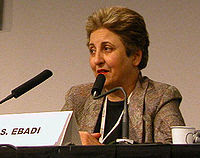
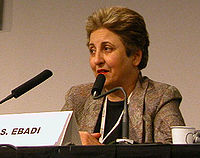
The first ever Muslim woman to have received the Nobel Prize was Shirin Ebadi, an Iranian Lawyer and a former judge and human rights activist. On October 10, 2003, Ebadi was awarded the Nobel Peace Prize for her significant and pioneering efforts for democracy and human rights, especially women'schildren's, and refugee rights.

Shirin Ebadi – The First ever Muslim woman to have received the Nobel Prize
OSLO, Norway — Three women who fought injustice, dictatorship and sexual violence in Liberia and Yemen accepted the 2011 Nobel Peace Prize on Saturday, calling on repressed women worldwide to rise up against male supremacy.
"My sisters, my daughters, my friends – find your voice," Liberian President Ellen Johnson Sirleaf said after collecting her Nobel diploma and medal at a ceremony in Oslo.
Sirleaf, Africa's first democratically elected female president, shared the award with women's rights campaigner Leymah Gbowee, also from Liberia, and Tawakkul Karman, a female icon of the protest movement in Yemen.
By selecting Karman, the prize committee recognized the Arab Spring movement that has toppled autocratic leaders in North Africa and the Middle East. Praising Karman's struggle against Yemen's regime, Nobel committee chairman Thorbjoern Jagland also sent a message to Syria's leader Bashar Assad, whose crackdown on rebels has killed more than 4,000 people according to U.N. estimates.
"No dictator can in the long run find shelter from this wind of history," Jagland said. "President Assad in Syria will not be able to resist the people's demand for freedom of human rights."
Karman is the first Arab woman to win the prize and at 32 the youngest peace laureate ever. A journalist and founder of the human rights group Women Journalists without Chains, she also is a member of the Islamic party Islah.
Wearing headphones over her Islamic headscarf, she clapped and smiled as she listened to a translation of Jagland's introductory remarks.
Karman paid tribute to Arab women "without whose hard struggles and quest to win their right in a society dominated by the supremacy of men I wouldn't be here," according to an English translation of her acceptance speech in Arabic.
She criticized the "repressive, militarized, corrupt" regime of outgoing President Ali Abdullah Saleh, but also lamented that the revolution in Yemen hasn't gained as much international attention as the revolts in Egypt, Tunisia, Libya and Syria.

"This should haunt the world's conscience because it challenges the very idea of fairness and justice," Karman said.
No woman or sub-Saharan African had won the prize since 2004, when the committee honored Wangari Maathai of Kenya, who mobilized poor women to fight deforestation by planting trees.
Sirleaf, 73, was elected president of Liberia in 2005 and won re-election in October. She is widely credited with helping her country emerge from an especially brutal civil war.
Jagland, the Nobel chairman, noted that she initially supported Charles Taylor but later dissociated herself from the former rebel leader who is now awaiting judgment from the International Criminal Court on charges of war crimes in Sierra Leone.
Gbowee, 39, long campaigned for the rights of women and against rape, challenging Liberia's warlords. In 2003, she led hundreds of female protesters through Monrovia to demand swift disarmament of fighters, who continued to prey on women, despite a peace deal.
"We used our pains, broken bodies and scarred emotions to confront the injustices and terror of our nation," she told the Nobel audience in Oslo's City Hall.
She called the peace prize a recognition of the struggle for women's rights not only in Yemen and Liberia, but anywhere that women face oppression.
"We must continue to unite in sisterhood to turn our tears into triumph," Gbowee said. "There is no time to rest until our world achieves wholeness and balance, where all men and women are considered equal and free."
Last year's peace prize went to imprisoned Chinese dissident Liu Xiaobo, who was represented by an empty chair at the awards ceremony as an infuriated China would not allow him to travel to Norway.
The other Nobel Prizes – in medicine, chemistry, physics and literature, and the Nobel Memorial Prize in Economic Sciences – were presented by Swedish King Carl XVI Gustaf at a separate ceremony Saturday in Stockholm.
In an emotional moment, Claudia Steinman accepted the Nobel diploma and medal on behalf of her husband, Canadian-born Ralph Steinman, who died of cancer just days before the medicine prize was announced in October. Before sitting down, she blew a kiss toward the ceiling of Stockholm's Concert Hall.
An exception was made to Nobel rules against posthumous awards because the jury wasn't aware of Steinman's death when it tapped him to share the award with American Bruce Beutler and French scientist Jules Hoffman for discoveries about the immune system.
The typically stiff white-tie crowd erupted in cheers when wheelchair-bound Swedish poet Tomas Transtromer, partially paralyzed by a stroke two decades ago, received the Nobel Prize in literature. The 80-year-old had figured in Nobel speculation for so many years that even his countrymen had started to doubt whether he would ever win.
U.S.-born scientists Saul Perlmutter, Brian Schmidt and Adam Riess collected the physics prize for discovering that the universe is expanding at an accelerating pace.
The chemistry award went to Israel's Dan Shechtman for his discovery of quasicrystals, a mosaic-like chemical structure that researchers previously thought was impossible.
Americans Christopher Sims and Thomas Sargent won the economics prize for describing the cause-and-effect relationship between the economy and government policy.
Worth 10 million kronor ($1.5 million) each, the Nobel Prizes are always handed out on the anniversary of award founder Alfred Nobel's death in 1896.


Listen to Leymah Gbowee at Los Angeles Library on October 3, 2011.
http://www.youtube.com/watch?v=l-hX2w2oQWA

Pasadena Civic Auditorium – Ruben Matevosyan, Armenian singer, in concert.


“Odar Aperoom…” (on foreign shores)
The following is a column I've submitted to Asbarez newspaper. An Armenian tale...

On Sunday morning, my sister-in-law called and said she had one extra ticket for Ruben Matevosyan’s sold out concert at the Pasadena Civic Auditorium that evening. I told her that I could use the ticket.

It’s fair to say that Maestro (as they call him) Ruben Matevosyan has been one of the most popular and respected folklore singers of Armenia for the last four decades.  Recently, he was in the news when on the occasion of the 20th anniversary of the Republic of Armenia's independence he, alongside of the legendary singer Ofelia Hambardzumyan, received the “Sourp Mesrob Mashtots” medal for his exceeding merit and great service to Armenian song and culture.

Thinking back to my childhood, I remember that before Matevosyan, Hovannes Badalyan was the star folksinger. We Iranian-Armenians especially liked Badalyan because he had migrated from Iran to the Soviet Union. I guess we felt a kinship with him, and of course he had a golden voice too.

In Tehran, among Armenian households it was common in the evenings to gather around the radio and listen to the broadcast from Yerevan.  Our parents were delighted that they could hear Radio Yerevan and become familiar with Armenian songs and the latest cultural trends.

As kids we weren't so interested in listening the Radio Yerevan, but our parents' fascination told us volumes.  I’m not sure how 50 or even 60 years ago we got radio reception from the Soviet Union, but we did. 

I particularly remember one New Year’s Eve, probably in the late 1950s, when my parents were out and we kids gathered around the radio and listened to a play broadcast from Radio Yerevan.

Although the play is blurred in my mind, I can still recall its revolutionary theme. In those years, radio dramas were very popular.  With no visual component, the oratory and sound effects were so powerful that they stirred a lot of emotions.  I couldn't say, now, how such a revolutionary theme was allowed in those days to be broadcast by Radio Yerevan.

The play was about a fight between a group of young Armenians and government officials.  Now that I search deep in my mind, this might be the only radio drama I can still recall from that era. At the climax of the play officials capture the protagonist, a young woman, and escort her into a streetcar, and we hear her shouting, “Yes, Dashnaktzakanem.” I can still hear her voice from the streetcar, screaming that she is a Dashnak.  And that’s how the play ended or at least that’s the way I remember it ending.

Back to Matevosyan… A sold out concert truly meant sold out. Built in 1932, the historic Pasadena Civic Auditorium has a total of 3,029 seats. ARTN Shant TV, which organized the lovely 70th birthday celebration for Matevosyan, told me that indeed, all 3,029 seats were sold.
I picked up my mother-in-law and her friend and drove from Glendale to Pasadena, a short 10-minute drive. To avoid the regular Sunday afternoon traffic on Colorado Street, I exited at Fair Oaks and took side streets. Soon I realized that everyone seemed to have my route in mind. The line to make a left onto Green Street was 3 blocks long, maybe a 15 to 20-minute wait. I got another bright idea; I continued straight on Marengo, crossed Green Street and entered the parking lot of the Sheraton Hotel right behind the Civic Auditorium. I was happy to beat the crowd.
Ruben Matevosyan established his place as one of the most popular Armenian singers during his twenties. Today at 70, he is considered the greatest master of Armenian songs. The concert was an unprecedented tribute to him as a legendary singer from abroad in "odar aperoom" – on foreign shores. 
The concert was peppered with duets of Matevosyan singing with younger singers such as Alla Levonyan, Armand Hovannesyan and Hovannes Shahbazian. Some songs were accompanied by dance ensembles and we also heard a few solo performances on traditional Armenian instruments. Each performance was followed by a rousing applause and at the end of the concert there was an enthusiastic standing ovation. It is heartwarming to see the outpouring of support for Armenian arts and culture in “odar aperoom.”
A few days before the concert, on Friday December 2nd, there was a screening of Suzanne Khardalian’s “Grandma’s Tattoos.”  The crowd gathered at the Glendale Main Library for this event was again at capacity – around 300. In fact, the organizers had to turn away about 100 people.
The outbursts of enthusiasm I’ve seen on these “foreign shores,” certainly indicate that Diaspora is firmly standing behind the Armenian cause. And I hope the outpouring of the support will continue and even grow bigger. 

Friday, 9 December 2011

A Corrupt Ex-governor Sentenced to 14 Years of Prison

The Shameful Story of Rod Blagojevich
Blagojevich the 55 year old  ex-governor of Illinois has been sentenced to 14 years prison, attempting to barter President Obama's vacated Senate seat. Here is the story adapted from Internet


CHICAGO (AP) — Rod Blagojevich, the ousted Illinois governor whose three-year battle against criminal charges became a national spectacle, was sentenced to 14 years in prison Wednesday,(12,7,2011) one of the stiffest penalties imposed for corruption in a state with a history of crooked politics.
Blagojevich's 18 convictions included allegations of trying to leverage his power to appoint someone to President Barack Obama's vacated Senate seat to raise campaign cash or land a high-paying job.
"When it is the governor who goes bad the fabric of Illinois is torn and disfigured and not easily repaired," Judge James Zagel said.
The twice-elected Democrat is now the second former Illinois governor in a row to be sentenced to prison, and the fourth Illinois governor in the last four decades. His Republican predecessor, George Ryan, currently is serving a sentence of 6 1/2 years, also for corruption.
Blagojevich, in a last plea for mercy, tried something he never had before: an apology. After years of insisting he was innocent, he told the judge he'd made "terrible mistakes" and acknowledged that he broke the law.
"I'm here convicted of crimes ... ," Blagojevich said, "and I am accepting of it, I acknowledge it and I of course am unbelievably sorry for it."
But Zagel gave him little leeway, telling him that he gave him credit for taking responsibility but that his apology didn't mitigate his crimes.

“Whatever good things you did for people as governor, and you did some, I am more concerned with the occasions when you wanted to use your powers when you wanted to do things that were only good for yourself."
Blagojevich's attorneys had said the sentence of 15 to 20 years prosecutors wanted was too harsh. The defense also presented heartfelt appeals from Blagojevich's family, including letters from his wife Patti and one of his two daughters that pleaded for mercy.

But the judge made it clear early in the hearing that he believed that Blagojevich had lied on the witness stand when he tried to explain his scheming for the Senate seat, and he did not believe defense suggestions that the former governor was duped by his advisers.
It is highly unlikely the 54-year-old will be taken immediately into custody. In white-collar cases, convicted felons are usually given at least a few weeks to report to prison while federal authorities select a suitable facility. Blagojevich is expected to appeal his conviction, but it is unlikely to affect when he reports to prison.
Going into the sentencing, many legal experts said the governor – who became a national punch line while doing several reality TV appearances while his legal case unfolded – was likely to get around 10 years. A former Blagojevich fundraiser, Tony Rezko, recently was sentenced to 10 1/2 years, minus time served, and many were confident the governor would get more.
Prosecutors have said Blagojevich misused the power of his office "from the very moment he became governor." He was initially elected in 2002 on a platform of cleaning up Illinois politics in the midst of federal investigations that led to the prosecution and conviction of Ryan.
"Blagojevich engaged in extensive criminal conduct with and without Rezko, provided no cooperation, perjured himself for seven days on the witness stand, and has accepted no responsibility for his criminal conduct," prosecutors said. And they said Blagojevich, who campaigned as a reformer, was "acutely aware of the damage" Ryan had created.
Defense attorneys have said he has already paid a price in public ridicule and financial ruin, and propose a term of just a few years.
Blagojevich's sentencing came just days before his 55th birthday on Saturday, and nearly three years to the day of his arrest at dawn on Dec. 9, 2008, when the startled governor asked one federal agent, "Is this a joke?" In a state where corruption has been commonplace, images of Blagojevich being led away in handcuffs still came as a shock.
It took two trials for prosecutors to snare Blagojevich on sweeping corruption charges. His first ended deadlocked with jurors agreeing on just one of 24 counts – that Blagojevich lied to the FBI. Jurors at his retrial convicted him on 17 of 20 counts, including bribery and attempted extortion.
FBI wiretap evidence proved decisive. In the most notorious recording, Blagojevich is heard crowing that his chance to name someone to Obama's seat was "f---ing golden" and he wouldn't let it go "for f---ing nothing."
Blagojevich clearly dreaded the idea of prison time. Asked in an interview before his retrial about whether he dwelled on that prospect, he answered: "No. I don't let myself go there."
In the same interview, Blagojevich also explained that the family dog Skittles was bought after his arrest in to help his school-age daughters, Amy and Annie, cope with the stress of his legal troubles. He said he joked with them that, "If the worst happens (and I go to prison), you can get another dog and call him `daddy.'"
While Blagojevich will likely end up at a minimal security prison, he'll be largely cut off from the outside world. Visits by family are strictly limited, Blagojevich will have to share a cell with other inmates and he must work an eight-hour-a-day menial job – possibly scrubbing toilets or mopping floors – at just 12 cents an hour.
Most of the prisons where Blagojevich could end up are outside Illinois. One is in Terre Haute, Ind., where Ryan is serving his own sentence.

Sunday, 4 December 2011

Occupying the Thanksgiving Weekend...

Here is my take on ANC's grassroots conference:

Instead of flocking to the shopping malls on Thanksgiving weekend to grab the best bargains, around 500 people, concerned with Armenian issues, headed to the Universal City Sheraton to hear and learn about the latest developments in Armenian culture, the Hai-Tahd (the Armenian cause) and the challenges facing our homeland. Organized by the Armenian National Committee (ANC), Western Region, the three-day ANC Grassroots conference was a huge success.

My nationalistic impulses had already been fired up the day before, as I spent Thanksgiving Day cooking and at the same time watching the Armenia Fund Telethon that raised $12.3 million. The outpour of donations from all over the world was just overwhelming.

To acclimate myself, on Friday I arrived at the Sheraton hotel, well before the conference kicked off and shortly after the doors opened at noon. I was pleasantly surprised at the registration desk to receive a hefty and useful black canvas briefcase with deep pockets. This was included in the $49 heavily subsidized conference fee, along with two lunches, two breakfasts, and an evening cocktail reception!

The conference session began on Friday afternoon at 4:30 p.m. with a capacity audience. The first panel discussion, "Lights, Camera, Activate," was about ways in which film, music, and art can promote activism. Brilliant panelists included: Serj Tankian, lead singer/songwriter of the band System of a Down; director/producer Carla Garapedian of award winning documentaries "Screamers" and "Lifting the Veil"; film director/screenwriter Erik Nazarian, whose latest short film "Bolis" has made headways; music composer Eric Hachikian, who has many accolades under his belt and whose latest film "Voyage to Amasia" will premiere at the Pomegranate Film Festival in Toronto December 4; and last but not least was Suzanne Khardalian, director/producer who lives in Stockholm, Sweden.  Khardalian stirred our emotions by discussing her newest documentary, “Grandma’s Tattoos.” A fact not known to me was the bitter story of women abducted during the Armenian Genocide and forced into prostitution.  They were forcibly tattooed as a sign that they belonged to their abductors. In 1988, Khardalian won the award of the Best Swedish Film, for her documentary “Back to Ararat.”

The first panel discussion was followed by a cocktail reception on the top floor of the hotel, the majestic Starview Room, where participants could rub elbows with panelists and become acquainted with the activities and the upcoming programs of the next two days.

On Saturday morning, we were jolted, not by an earthquake, but by the facts and statistics we heard at the panel discussion of the “Homeland and the Diaspora.” The panelist Alex Sardar, Chief of Party at Counterpart International Armenia, discussed the challenges that we are facing and the ongoing exodus from Armenia. He hammered this absurd thought into our heads: "the year 2058 – one person," meaning: if we take into consideration the low birth rate and the existing high rate of emigration from Armenia, by the year 2058 the country will be left with one person!
The highlight of the event, for me, came when Ayse Gunaysu, the Turkish human rights advocate, captivated the audience with her soft-spoken words. She explained a pivotal shift happening among the Turkish people in recognizing the Armenian Genocide.  She stressed that our adversaries are not the Turkish masses but the government.  I had to fight back tears when she said, “I’ve brought with me a message from my people – my people are sending their apologies…” She finished her talk with two words, “irreparable and incurable.”
The conference culminated with an exquisite luncheon in the hotel’s main banquet hall. We had the pleasure of hearing Mark Arax, one of the finest journalists of our time, as our keynote speaker. He shared personal stories of how his grandfather was transplanted to Fresno after being hidden a full year in an attic in Turkey.
He also told us about interviewing an old Armenian woman and hearing her memories of how the Turks treated young women, including having them dance and firing bullets into their feet. The woman told Arax that she had still a bullet left in one of her hips from that incident.
After hearing all the speakers and the panelists, we felt that we were richer in our views and understanding the challenges that our homeland is facing. The conference opened countless hearts; it certainly did open mine.  It gave me a new perspective into the work that ANC is leading for the Hai-Tahd. It was a good reason to skip the malls this past weekend and instead take part in an enriching and educational three-days conference. 

Saturday, 3 December 2011

Armenians, Raised as Muslims, Baptized in Diyarbakir, Turkey

The following story was adapted from the Asbarez Newspaper:
A scene from the inaugural Mass at Diyarbakir church
DIYARBAKIR—A group of Armenians, raised as Sunni Muslims because their ancestors converted to Islam after the Armenian Genocide, were reportedly baptized in October of this year at the newly re-opened Surp Giragos Church, reported Hurriyet Daily News.
“I wish this church had always been open,” Gaffur Türkay, one of the group to be baptized, who also contributed to the restoration of the church, told Hurriyet. “It is unbelievable to be together here with people from all around the world with whom I share the same origins.”
Istanbul’s Deputy Patriarch Aram Ateshian was scheduled to officiate at the baptismal ceremony, which was held behind closed doors and was not open to the press. The newspaper reported that the names of those baptized would not be publicized due to security concerns.
Hurriyet also caught of with Turkish-born Archbishop Vicken Ayvazian, who was representing the Eastern US Diocese of the Armenian Church.
“We used to have over 2,600 churches and monasteries across Anatolia in the past. Unfortunately, only a handful of sanctuaries remain. My request from Turkey as a spiritual leader is for churches to be returned to the [Armenian] community, rather than reopening them for religious service as museums,” Archbishop Ayvazian told Hürriyet.
He also told Hurriyet that “there was a Genocide,” saying an acknowledgement of the fact can be a step toward the right direction.
Used as a command center for German officers during the First World War, the church was then used as an apparel depot by the state-owned Sümerbank until 1950. The church was then handed back to the Armenian community, following a long legal battle, reported Hurriyet.


Restoration of the Church...

Officials from Turkey, Armenia and the Armenian diaspora are expected to attend a Divine Liturgy to celebrate the church’s reopening, which is scheduled for later this year.
“After the restoration process, we are planning to draw faith tourists from around the world,” Surp Giragos Armenian Church Foundation Chairman Ergün Ayık recently told the Hürriyet Daily News & Economic Review.

The coming Armenian religious service marks a second for the region after the Divine Liturgy was held last September at the Surp Haç Armenian Church on Van’s Akdamar Island, drawing top Turkish officials, Turkish-Armenians and members of the diaspora.

Unlike Surp Haç, however, Surp Giragos will remain in the possession of the Armenian community after restoration is complete. The Istanbul Armenian Foundation coordinated the church’s restoration, drawing funds from diaspora Armenians, as well as Diyarbakır Metropolitan Municipality, which is expected to meet one-third of the restoration budget. The Turkish government, meanwhile, has promised to provide 25,000 Turkish Liras toward the church’s refurbishment.
The church is the first in Anatolia to be restored by Armenians, Ayık said, adding that they initially had problems with the country’s Culture Ministry.

“Right before the restoration we asked for support from the ministry but we were told to hand over the ownership of the church to the ministry in return for support. If we had accepted it, Surp Giragos would have opened as a museum like [Surp Haç] in Van,” the chairman said.
Culture Minister Ertuğrul Günay visited Diyarbakır to examine the restoration process at the church a few months ago, Ayık said. “He said he would provide a budget of 25,000 liras for the restoration, but we have not received it yet.”
Only family in Diyarbakır

According to some art historians, the church is the largest in the Middle East. The complex sprawls over 3,200 square meters and includes priests’ houses, chapels and a school. The church was seized by the German army in 1913 and served as their local headquarters until 1918, when it was converted into a fabric warehouse.

Ayık also said Surp Giragos had several unique architectural features. “Churches normally have one altar but Surp Giragos has seven altars. Its original roof was covered with the earth from around the region. We will do it again. The earth has been stripped of seeds to prevent the growth of plants. It should also be vented regularly, every year.
The chairman, whose family is originally from the southeastern province, said the church was handed over to the foundation by the General Directorate of Foundations in the 1950s and continued providing church services until 1980.
By the 1980s, there were only five Armenian families left in the province; now, however, there is just one.
“In accordance with the law of foundations, people had to live in the cities where they worked for foundations in Anatolia, but there was no Armenian society in the city. This is why the church was left alone, without a society, and looted by treasure hunters,” he said, adding that only the Hatay-Vakıflıköy, Kayseri and Diyarbakır churches survived today among the 2,000 churches and monasteries that once dotted Anatolia.

“These churches do not just belong to us; they are the cultural heritage of Turkey. We should preserve them,” Ayık said.

Ayık also said he had asked for help from diaspora Armenians living in different countries throughout the world.

“They ask why we are restoring a church that does not even have a society and whether it will be turned into a museum,” he said. “I have explained to them the importance of protecting these structures and have tried to persuade them that it will not become a museum [out of the control of Armenians].
The chairman, however, said the foundation planned to turn one of the chapels into a museum.
“We will display the lifestyle of Diyarbakır’s Armenians. There will also be concerts and exhibitions. In this way, the church will be able to finance itself,” Ayık said.